Syporka: The Stencil Font That Keeps Your Creativity Flowing
There's a particular kind of frustration that hits when you're deep in a project—maybe you're cutting vinyl for a craft fair, setting up a sublimation print run, or finalizing packaging mockups—and the font you chose just won't cooperate. The blade catches on tight curves. The ink bleeds into closed letterforms. The whole design loses crispness at smaller sizes. If you've been there, you already understand why a stencil font like Syporka exists, and why it's become a quiet favorite among designers and makers who need their typography to actually perform in the real world.
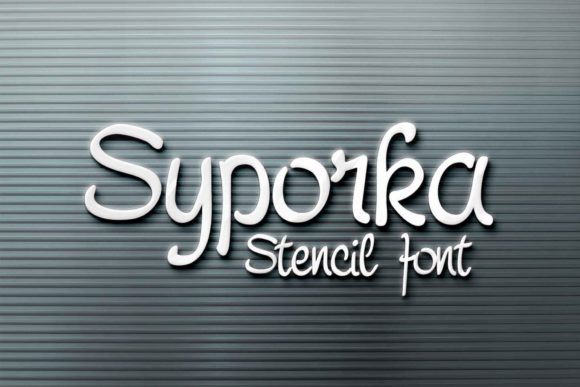
Syporka Stencil is a carefully crafted typeface designed without closed loops on its characters. That's a technical way of saying the letters have small breaks or openings built into them, which is exactly what makes them work so well for cutting, printing, and crafting applications where traditional fonts fall apart. But here's what matters more than the mechanics: Syporka looks good. It doesn't sacrifice style for function. The letterforms feel intentional, balanced, and modern—whether you're using them on a product label, a social media post, or a hand-lettered sign for your market booth.
Why the Stencil Style Works for So Many Projects
Stencil fonts occupy an interesting space in the typography world. They carry a certain ruggedness, an industrial edge, but they can also feel clean and contemporary depending on how they're designed. Syporka leans into that versatility. The characters are bold enough to command attention without feeling heavy or oppressive. The openings in the letterforms are placed thoughtfully, so the font remains highly legible even at smaller sizes or when rendered on textured surfaces.
For anyone working in physical production—whether that's screen printing T-shirts, laser-cutting wooden signs, or designing stencils for painting—the absence of closed loops isn't just a stylistic choice. It's a practical necessity. Fonts with enclosed counters (the interior spaces in letters like O, D, B, or A) can create problems during cutting processes because those interior pieces become disconnected islands. Syporka sidesteps this entirely, which means fewer production headaches and cleaner finished products.
But the appeal goes beyond manufacturing logistics. There's a visual confidence to stencil typography that communicates something specific: directness, authenticity, a no-nonsense attitude. Think about the brands and designs that use stencil-style lettering effectively. Military-inspired packaging. Artisan food labels. Outdoor lifestyle brands. Streetwear graphics. The font style carries cultural associations that can reinforce your brand message without saying a word.
Bringing Syporka into Your Brand Identity
If you're building a brand from scratch or refreshing an existing visual identity, font selection is one of the most consequential decisions you'll make. Typography is the voice of your brand before anyone reads a single word of copy. It sets expectations, communicates personality, and creates the visual rhythm that ties all your materials together.
Syporka works particularly well for brands that want to project strength, creativity, and approachability simultaneously. It's not trying to be precious or overly refined. It's direct. A small-batch hot sauce company could use it for labels and social graphics. A fitness studio might choose it for motivational wall art and class schedules. A woodworking business could apply it to product tags and website headers. The font adapts to the context while maintaining its core character.
One practical consideration when incorporating any display font into a brand system is pairing. Syporka's bold, structured letterforms pair well with simpler sans serif fonts for body text. Think of it this way: let Syporka handle the headlines, the logo, the call-to-action moments where you need visual impact. Then let a clean, neutral typeface do the heavy lifting for longer paragraphs, product descriptions, and informational copy. This contrast creates visual hierarchy and keeps your designs from feeling monotonous.
Practical Applications Across Print and Digital
The beauty of a font like Syporka is that it doesn't live in just one category of use. It moves fluidly between physical and digital applications, which is exactly what most modern creators need. Your brand likely exists across multiple touchpoints—your website, your Instagram feed, your product packaging, your printed materials—and you need typography that performs consistently across all of them.
For print projects, Syporka excels on merchandise like T-shirts, tote bags, and hats where the stencil aesthetic feels natural and intentional. It's equally effective on invitations, event posters, and editorial layouts where you want a headline font with personality. The stencil construction means it reproduces well even on lower-quality printing surfaces, which is a genuine advantage for small businesses that can't always afford premium printing on every project.
On the digital side, the font translates beautifully to social media graphics, website headers, blog post titles, and email marketing visuals. Its boldness makes it readable even in the fast-scrolling environment of platforms like Instagram or Pinterest, where you have roughly a second to capture someone's attention. The distinctiveness of the stencil style helps your content stand apart from the sea of scripts and geometric sans serifs that dominate most feeds.
Getting the Most from Your Font Investment
A few practical tips for working with Syporka—or any premium font—in your projects. First, always check what styles and weights are included in your purchase. Many stencil fonts come with variations that give you more flexibility: regular and bold weights, alternate characters, or decorative additions. Knowing what's available helps you avoid buying additional fonts unnecessarily and keeps your visual system tighter.
Second, test your font choices at the actual sizes and on the actual surfaces where they'll appear. A typeface that looks perfect at 72 points on your laptop screen might feel cramped at 14 points on a business card, or it might lose definition when heat-pressed onto fabric. Print a test. Cut a sample. View it on your phone screen. Real-world testing catches problems that digital previews miss.
Third, pay attention to licensing. If you're using Syporka for commercial purposes—selling products, creating client work, distributing materials—make sure your license covers that use. Most premium font licenses distinguish between personal and commercial use, and some have specific terms for things like merchandise or digital product creation. This isn't the exciting part of design work, but it protects you legally and respects the work of the type designers who created the asset.
Matching Typography to Your Creative Goals
Font selection should always start with intention. Before you browse font libraries or download samples, get clear on what your project needs to communicate. Are you going for bold and industrial? Warm and handcrafted? Minimalist and modern? The answers narrow your search and prevent the common trap of choosing a font because it looks cool in isolation rather than because it serves your specific goals.
Syporka occupies a particular niche: it's assertive without being aggressive, structured without feeling rigid, and distinctive without sacrificing readability. That combination makes it a strong candidate for projects where you need the typography to carry weight—literally and figuratively. If your design relies on a single typeface to do most of the visual heavy lifting, a well-crafted stencil font like this one can handle that responsibility gracefully.
The best typography decisions come from experimentation and honest evaluation. Try Syporka in your next project, set it alongside your existing brand fonts, and see how it feels. Sometimes the right typeface doesn't just improve a design—it clarifies the entire direction of your visual communication.